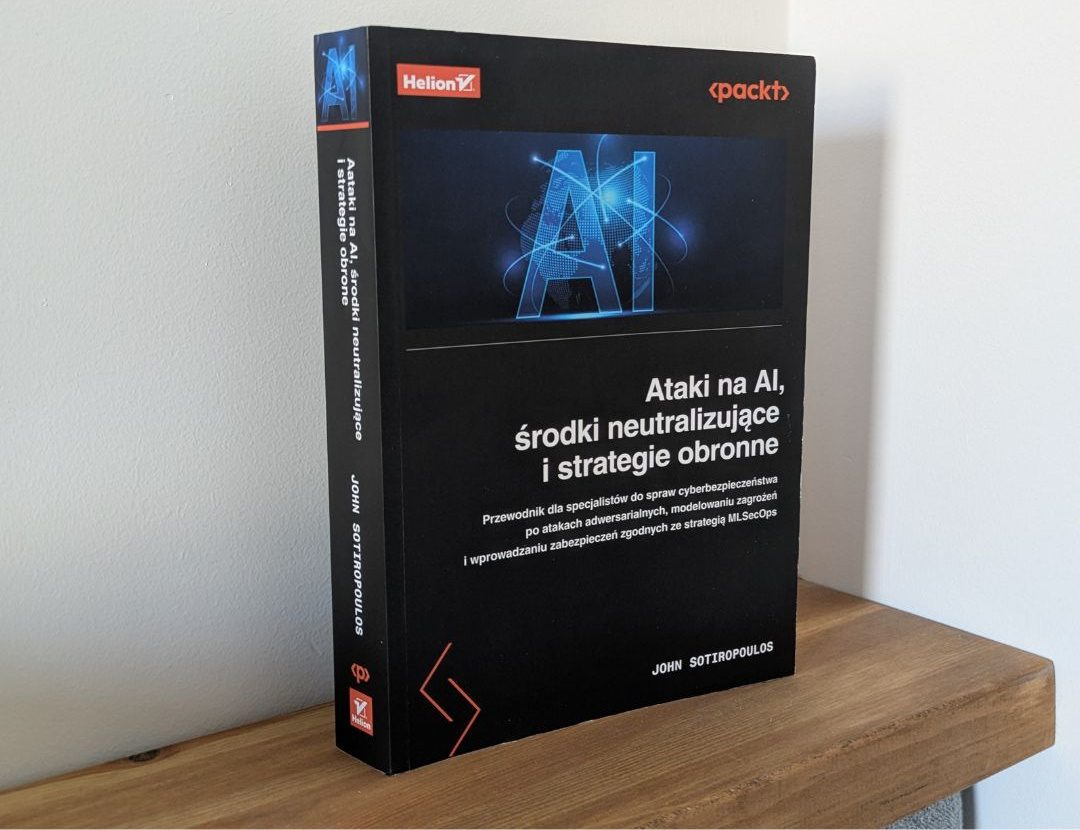
The book Adversarial AI Attacks is unusual.
On the one hand, it can genuinely put you off while reading it, and yet I kept wanting to come back to it. It’s not Stockholm syndrome, but rather the real value it carries. But let’s get to the point.
At the beginning, we are met with an introduction, and it is quite strange. On the one hand, it introduces the topic of AI, but it does so in a very condensed, slogan-like manner. It feels as if it was written exclusively for people who are already very familiar with these concepts. At times, it resembles a conversation with a friend who wants to show off how many complex terms they know.
Another distinctive feature of the book appears here as well: the translation of technical terms into Polish. Initially, this is handled quite reasonably. Polish equivalents are provided alongside the original English terms. However, later in the book, only the Polish names are used, which makes reading more difficult, as it requires constantly recalling their English origins.
It is clear that the book was written by a highly technical person. It is not an easy read, yet despite that, I still felt compelled to return to it.
There are very few books on the market that focus on more sophisticated attacks on AI. Most publications stop at simpler threats, such as Prompt Injection or Unbounded Consumption. And that’s no surprise—it’s easy to compare them to classic attacks like SQL Injection or DoS. This book goes a step further and concentrates on lesser-known, more difficult attacks that often require specialized tools and/or knowledge of advanced mathematics. In this area, it offers an enormous amount of knowledge.
The structure is fairly systematic—each attack includes a description, its variants, industry examples, and methods for independent replication. Each one is also accompanied by a reference to the original academic research.
For this reason, I treat this book as a kind of lexicon of AI attacks, built on academic research. It is an excellent reference point—both for learning and for revisiting later when an opportunity arises to apply the described techniques (of course in testing, not in offensive use 😉). That is precisely why I see its schematic nature as an advantage.
The same applies to the source code—on a first reading, it can be skipped, but during deeper study, it becomes very useful. The downside is that sometimes the sample code is difficult to analyze without the full version available on GitHub. Fortunately, that option exists, so the book excerpts can be treated as commentary on the repository. Unfortunately, the grayscale illustrations instead of color ones are less readable and make understanding more difficult.
In summary: “Adversarial AI Attacks” is a highly valuable book, though written in a demanding way. It requires considerable effort and has a high entry threshold—definitely intended for readers who already have solid knowledge of AI. In return, however, it delivers an enormous amount of insight. It is hard to find another book in this field so densely packed with substantive material.